|
 |
 |
40Gb/s DPSK Receivers |
|
|
|
|
| |
|
|
- Description
- Features
- Applications
- Specification
 Product Description - 40Gb/s Integrated DPSK Receivers Product Description - 40Gb/s Integrated DPSK Receivers |
|
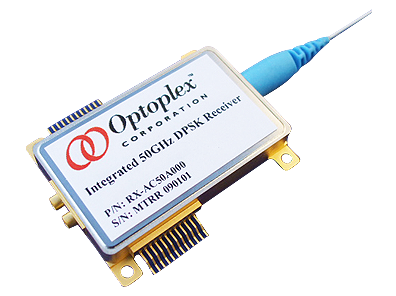
Targeting for the next-generation 40Gb/s system based on advanced optical differential phase shift keying (DPSK) demodulation, Optoplex’s 40Gb/s Integrated DPSK Receiver (DPSK Rx) demodulates an incoming DPSK optical signal into a pair of differentially (amplitude) modulated RF outputs at data rate up to 43Gb/s in a compact package.
Phase modulated optical signals offer much better dispersion performance compared with traditional amplitude modulated counterparts because the carrier light stays on all the time so that the intensity-dependent nonlinear effects in the transmission link are avoided, resulting in longer transmission distances.
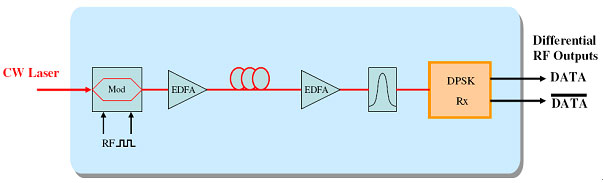
The integrated DPSK receiver combines a delay-line interferometer (DLI) with a balanced receiver to achieve compact size in a butterfly package. Compared with discrete components, the integrated receiver couples optical outputs from the DLI directly into the balanced photodetectors, resulting in smaller insertion loss and low channel skew, in addition to the elimination of fiber routing and matching.
The DLI demodulator is based on Optoplex’s proprietary, patent-pending free-space micro-optics, through which the incoming phase modulated optical signal is converted into a pair of differential, amplitude-modulated optical signal for detection by the balanced photodetectors. Due to its unique materials and design, the DLI exhibits highly athermal behavior in terms of insertion loss and phase error. The RF outputs from the balanced photodetectors are further amplified by a limiting TIA. As optional features, monitoring input tap with PD and/or 3dB attenuation (on one arm) can also be incorporated into the package.
Optoplex’s 40Gb/s Integrated DPSK Receivers can be configured at different FSR such as 43GHz, 50GHz, 57GHz or other customer specified values. A colorless version with the spectrum peaks aligned to the ITU grid is also available. |
|
| Features and Benefits of 40Gb/s Integrated DPSK Receivers |
|
- Compact size
- Low insertion loss
- Low phase error
- <1 ps skew
- Customizable FSR
|
|
| Applications |
|
 |
| 40Gb/s Integrated DPSK Receiver Product Datasheet |
|
|
| Standard Specifications of DPSK Demodulator |
|
Parameter |
|
|
| Wavelength Range (C-band) |
nm |
1520 -1570 |
| Free Spectral Range (typical)2 |
GHz |
21.5, 25, 33.3, 43, 50, 57, 65, 66.7 |
| Temperature Dependent Frequency Shift |
GHz |
< 10 |
| Extinction Ratio |
dB |
> 16 |
| Skew |
ps |
< 1.0 |
| Phase Tuning Range |
FSR |
> 1.5 |
| Polarization Dependent Phase Shift |
deg |
< 5 |
| Differential Conversion Gain |
V/W |
> 1500 |
| Differential Output Eye Amplitude |
mVpp |
550 |
| DC Responsivity @ Optimum DLI Phase |
A/W |
> 0.2 |
| Optical Input Power |
dBm |
-6 to
+8 |
| Polarization Dependent Loss |
dB |
< 0.6 |
| Optical Return Loss |
dB |
> 27 |
| Bit Rate (NRZ-DPSK) |
Gbps |
43 |
| O-E Bandwidth (S21 3dB Cut-off Frequency) |
GHz |
> 28 |
| Photodiode Dark Current (per PD) |
nA |
< 100 |
| Electrical Return Loss (S22) |
dB |
-10 (DC-20GHz)
-4 (20-45GHz) |
| Amplifier Supply Voltage |
V |
-5.2 |
| Power Consumption |
W |
< 1.5 |
| Phase Tuning Speed |
s |
< 1 |
| OSNR Performance |
dB |
20 |
| Package Dimensions (excluding collimator
sleeves and electrical pins) |
mm |
50 x 30 x 7.5 |
|
Notes:
- Over the stated spectral and operating temperature ranges and all polarization states.
- Other FSR available upon request.
|
|
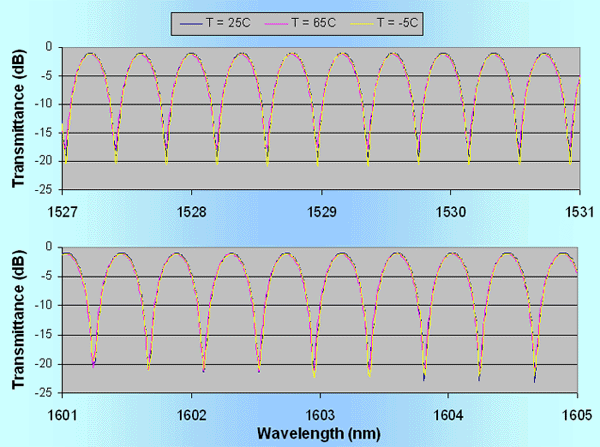
| Typical Performance of DPSK Demodulator |
|
|
|
| Parameter Definition of DPSK Demodulator |
|
Parameter
Definition |
Example |
Wavelength
Range is defined as spectral range over which the DPSK demodulator can operate. |
1528.77 ~ 1563.86 nm |
DPSK is acronym for Differential Phase-Shift Keying |
- |
DLI is acronym for Delay Line Interferometer. |
- |
DQPSK is acronym for Differential Quaternary Phase-Shift Keying |
- |
DPSK Demodulator is a component that converts phase modulation into amplitude
modulation. |
- |
Insertion
Loss (dB) is the relative peak power level
transmitted to the output ports referenced to the 0-dB reference level when
the DPSK demodulator is inserted. "On" and "Off" ports
are reported separately. |
1.7 dB |
Insertion
Loss Uniformity (dB) is defined as
maximum insertion loss difference between the adjacent channels of the two
output ports across the whole operating wavelength range. |
0.5 dB |
Isolation/Extinction
Ratio (dB) is defined as the power difference
between peak and valley of the spectrum. "On" and "Off"
ports are reported separately. |
18 dB |
Polarization
Dependent Loss (PDL) (dB) is the power difference
between the two extreme polarization states. "On" and
"Off" ports are reported separately. |
0.2 dB |
Polarization
Dependent Frequency Shift (PDFS) (deg) is the
maximum frequency difference measured at the valley of power spectrum among
all polarization states. |
3 deg |
Optical
Return Loss (dB) is the ratio between the input
power and the reflected power over all polarization states at each port , RL = -10×log10(Pr/Pin). |
40 dB |
Tuning
Range (TR) (GHz) is the maximum shift variation
of a center frequency of the spectrum driven by applying control voltage to
DPSK demodulator. |
1.5×FSR |
Tuning
Speed (TS) (second) is the time needed by the
device to tune the frequency to its half of target position. |
1 s |
Operating
Temperature (°C) is the ambient temperature
range over which the device's performance spec can be met. |
-5 to
65 °C |
Storage
Temperature (°C) is the ambient temperature
range over which the device can be stored without affecting its intended
application afterwards. |
-40 to
85 °C |
|
|
|
|
 |
| Product Request and Ordering Information |
| Please speak to Optoplex Sales persons. If you request custom-designed DPSK Rx product,
please provide the following parameters: |
- Wavelength range
- Fiber length
- Optical connector type
|
|
|
|
 |
|
|
| |
|
|
|