|
 |
 |
DQPSK Demodulator |
|
|
|
|
| |
|
|
- Description
- Features
- Applications
- Specification
- Parameter Definition
 Product Description - DQPSK Demodulator Product Description - DQPSK Demodulator |
|
Differential Quaternary Phase-Shift Keying (DQPSK) is the four-level version of DPSK. DQPSK transmits two bits for every symbol (bit combinations being 00, 01, 11 and 10) and has an additional advantage over conventional binary DPSK. DQPSK has a narrower optical spectrum, which tolerates more dispersion (both chromatic and polarization-mode), allows for stronger optical filtering, and enables closer channel spacing. As a result, DQPSK is the only modulation format which allows processing of 40Gb/s data-rate in a 50-GHz channel spacing system.
With DQPSK, the bandwidth of the drive electronics needs only be half of the bit rate. So 43 Gb/s signals can be generated with 21.5 Gb/s equipment. This allows system providers to achieve the expanded flexibility of reducing system cost by using low-speed drive electronics.
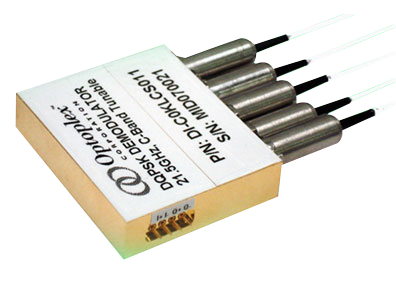
Optoplex's Optical DQPSK demodulator converts quadratural phase modulation into amplitude modulation over the entire C+L band in support of data transmission rate of 10 or 40 Gb/s. DQPSK demodulator is designed for the next generation optical communications systems utilized in commercial, defense and space exploration markets. The device plays a key role in improving signal quality and performance to meet the expanding demand for higher data rates and more complex transmission formats within current and next generation systems without major capital expenditure.
- DQPSK demodulator uses half the transmission rate to achieve the same data rate (20-Gb/s system for 40-Gb/s data rate, with four phase states instead of two in DPSK format)
- Lower transmission rate saves cost on many other components and electronics and is more tolerate of dispersion
- 20-Gb/s system is the highest transmission rate possible for the 50-GHz channel spacing
- Optoplex’s DQPSK demodulator currently provides a convenient solution for this application by using two matched DPSK demodulators with phase off-set at ± π/4. The co-packaged single-core DQPSK demodulator is also under development
For DPSK demodulator or Delay Line Interferometer, please visit DPSK Demodulator page. |
|
| Features and Benefits of DQPSK Demodulator |
|
- Athermal design
- C+L band coverage by a single device
- Low temperature-dependent frequency shift (TDFS)
- Low polarization-dependent frequency shift (PDFS)
- Wide bandwidth
- Low insertion loss & PDL
- High power handling
- Passive, semi-tunable and fully tunable operation
- Suitable for both RZ and NRZ modulation format
- Telcordia GR-1221 qualified
|
|
| DQPSK Demodulator Applications |
|
- 5 or 20 Gb/s DQPSK Signal Reception
- Data Rate Optimization
- Extend Transmission Distances
|
|
| Standard Specifications of DQPSK Demodulator |
|
Parameter |
Unit |
Specification |
|
Wavelength
Range (C-Band) |
nm |
1527 to 1567 |
|
Wavelength
Range (L-Band) |
nm |
1567 to 1607 |
| Free
Spectral Range1 (FSR, ~1/2 of the nominal data rate, a few typical
values are given) |
GHz |
10.7, 21.5, 28 or 32.5 |
| FSR
Error2 |
% |
< 1 |
| Insertion
Loss2 (including all connectors) |
dB |
5.7 Typical; 6.0 Max |
| Extinction
Ratio2 |
dB |
> 18 |
| PMD2 |
ps |
< 0.1 |
| Return
Loss |
dB |
> 40 |
| PDL2 |
dB |
< 0.2 |
| PDFS2 |
deg |
< 3 |
| Optical Path Delay2 (Skew,
among Input -> I1, I2, Q1, Q2) |
ps |
< 1.0 |
| Tuning
Range |
FSR |
> 1.5 |
| Tuning
Time Constant3 |
sec |
< 1.0 |
| Power
Consumption |
W |
1.0 Typical; 2.0 Max |
| Tuning
Voltage |
V |
0 to 5 |
| Maximum
Input Optical Power |
mW |
300 |
| Operating
Temperature |
°C |
-5 to 65 |
| Storage
Temperature |
°C |
-40 to 85 |
| Dimension (L x W x H)4 |
mm |
50x41x11 |
| Connector
Type |
- |
TBD |
| Fiber
Pigtail Type |
- |
SMF-28
with 900 µm loose tube |
| Fiber
pigtail length |
m |
1.0 ± 0 |
|
Notes:
- Values listed are typical examples, customer can specify.
- Over the stated spectral and operating temperature ranges and all polarization states.
- Defined as the time required to reach half-way from the starting and ending points.
- Not including five collimator sleeves extending from one longer side by 21 mm.
|
|
| Parameter Definition of DQPSK Demodulator |
|
Parameter
Definition |
Example |
Wavelength
Range is defined as spectral range over which the DQPSK demodulator can operate. |
1528.77 ~ 1563.86 nm |
DPSK is acronym for Differential Phase-Shift Keying |
- |
DLI is acronym for Delay Line Interferometer. |
- |
DQPSK is acronym for Differential Quaternary Phase-Shift Keying |
- |
DPSK Demodulator is a component that converts phase modulation into amplitude
modulation. |
- |
Insertion
Loss (dB) is the relative peak power level
transmitted to the output ports referenced to the 0-dB reference level when
the DPSK demodulator is inserted. "On" and "Off" ports
are reported separately. |
1.7 dB |
Insertion
Loss Uniformity (dB) is defined as
maximum insertion loss difference between the adjacent channels of the two
output ports across the whole operating wavelength range. |
0.5 dB |
Isolation/Extinction
Ratio (dB) is defined as the power difference
between peak and valley of the spectrum. "On" and "Off"
ports are reported separately. |
18 dB |
Polarization
Dependent Loss (PDL) (dB) is the power difference
between the two extreme polarization states. "On" and
"Off" ports are reported separately. |
0.2 dB |
Polarization
Dependent Frequency Shift (PDFS) (deg) is the
maximum frequency difference measured at the valley of power spectrum among
all polarization states. |
3 deg |
Optical
Return Loss (dB) is the ratio between the input
power and the reflected power over all polarization states at each port , RL = -10×log10(Pr/Pin). |
40 dB |
Tuning
Range (TR) (GHz) is the maximum shift variation
of a center frequency of the spectrum driven by applying control voltage to
DPSK demodulator. |
1.5×FSR |
Tuning
Speed (TS) (second) is the time needed by the
device to tune the frequency to its half of target position. |
1 s |
Operating
Temperature (°C) is the ambient temperature
range over which the device's performance spec can be met. |
-5 to
65 °C |
Storage
Temperature (°C) is the ambient temperature
range over which the device can be stored without affecting its intended
application afterwards. |
-40 to
85 °C |
|
|
|
|
 |
| Product Request and Ordering Information |
| Please speak to Optoplex Sales persons. If you request custom-designed DQPSK demodulator product,
please provide the following parameters: |
- Wavelength range
- Free spectral range (FSR)
- Passive, semi-tunable or fully tunable
|
- Fiber length
- Optical connector type
|
|
|
 |
|
|
| |
|
|
|